
Classical Approach to Science
“The most beautiful thing we can experience is the mysterious. It is the source of all true art and all science.” – Albert Einstein
Science at NorthShore Classical Academy
At NorthShore Classical Academy, science is taught with both intellectual rigor and a sense of purpose. Our students receive a strong, disciplined foundation in the core scientific fields—biology, chemistry, physics, and earth science—grounded in careful observation, mathematical reasoning, laboratory investigation, and clear scientific thinking. This preparation equips students for advanced STEM study, competitive colleges, and the many careers that rely on scientific and technical excellence.
At the same time, we believe science is more than a collection of technical skills or a narrow pathway to a single profession. Science is one of humanity’s greatest achievements—a systematic pursuit of truth that allows us to understand the natural order of the world. When taught well, it inspires curiosity, humility, and wonder, alongside precision and mastery.
Through our classical approach, students encounter science as both a rigorous discipline and a source of discovery. They study the structure of the cosmos and the laws that govern it; the elegance of biological systems and the human body’s remarkable capacity for healing; the patterns of the natural world on Earth and beyond; and the scientific and engineering insights of great minds such as Leonardo da Vinci. Students learn not only how scientific knowledge is built, but why it matters.
By graduation, NCA students possess a clear and accurate understanding of scientific models, theories, and laws—and the ability to think scientifically, analyze evidence, and solve complex problems. Science at NCA complements the humanities by examining a different dimension of truth, together forming a coherent and meaningful understanding of reality. The result is a graduate who is well prepared for STEM pathways, yet grounded in wisdom, perspective, and intellectual depth.
9th Grade – BIOLOGY
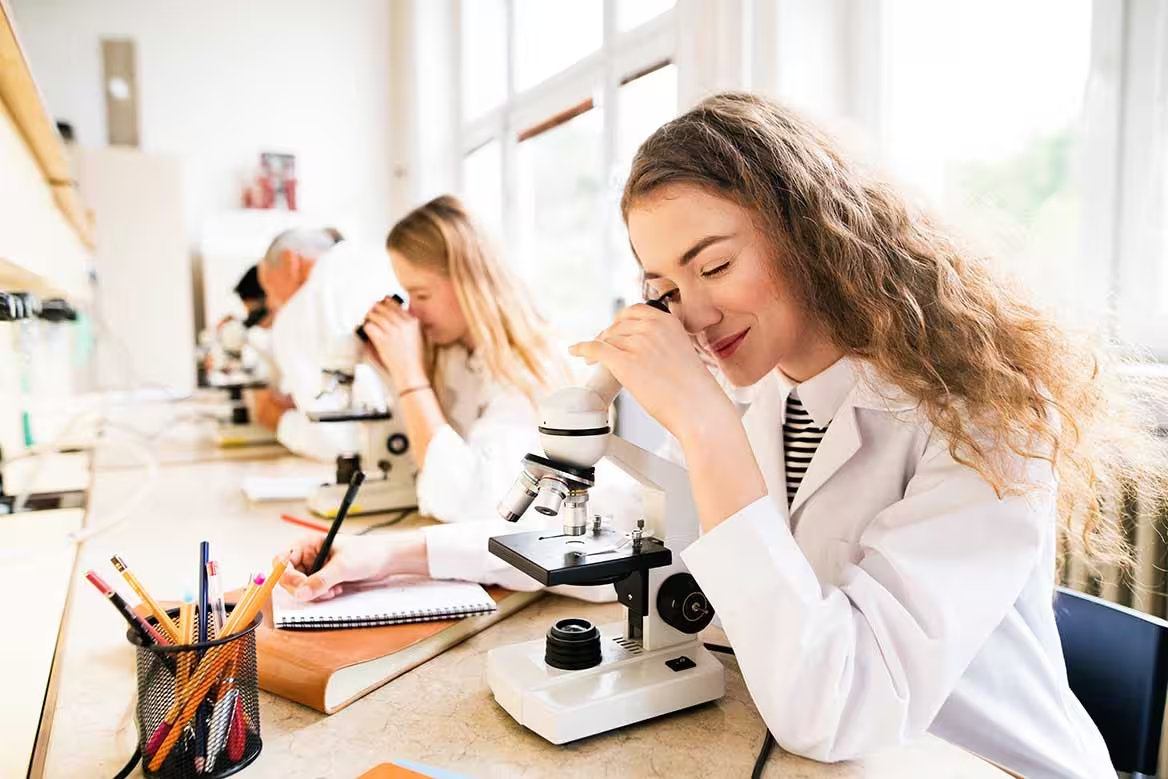
This course is a comprehensive survey of the science of biology. The course begins with a study of the basic chemical processes important to biology, then works its way through the study of the cell, genetics, organisms, and the classification of organisms. The course then moves into a study of the human body and concludes with an introduction to environmental science and the interaction of biological communities and their ecosystems. In-class presentations and discussions are complemented by laboratory experiments that teach students the processes of science and data interpretations, while they also reinforce the factual content of the curriculum.

10th Grade – CHEMISTRY
This course offers a survey of major theories, models, laws, and concepts of modern chemistry. Through rigorous experimentation, measurement, data interpretation and modeling, students will inquire about the nature and properties of matter, substance, substantial change, alteration, and material composition. Major units of study include modern atomic theory, the chemical elements, chemical bonding and formulas, stoichiometry, acid-based reactions, kinetics and chemical equilibrium, and states of matter and gas laws. Throughout the course, a special emphasis is placed on understanding and applying the scientific method, acquiring rigorous habits of observation and experimentation, and learning how to use measurements of matter to inquire into the nature of matter.
11th Grade – PHYSICS
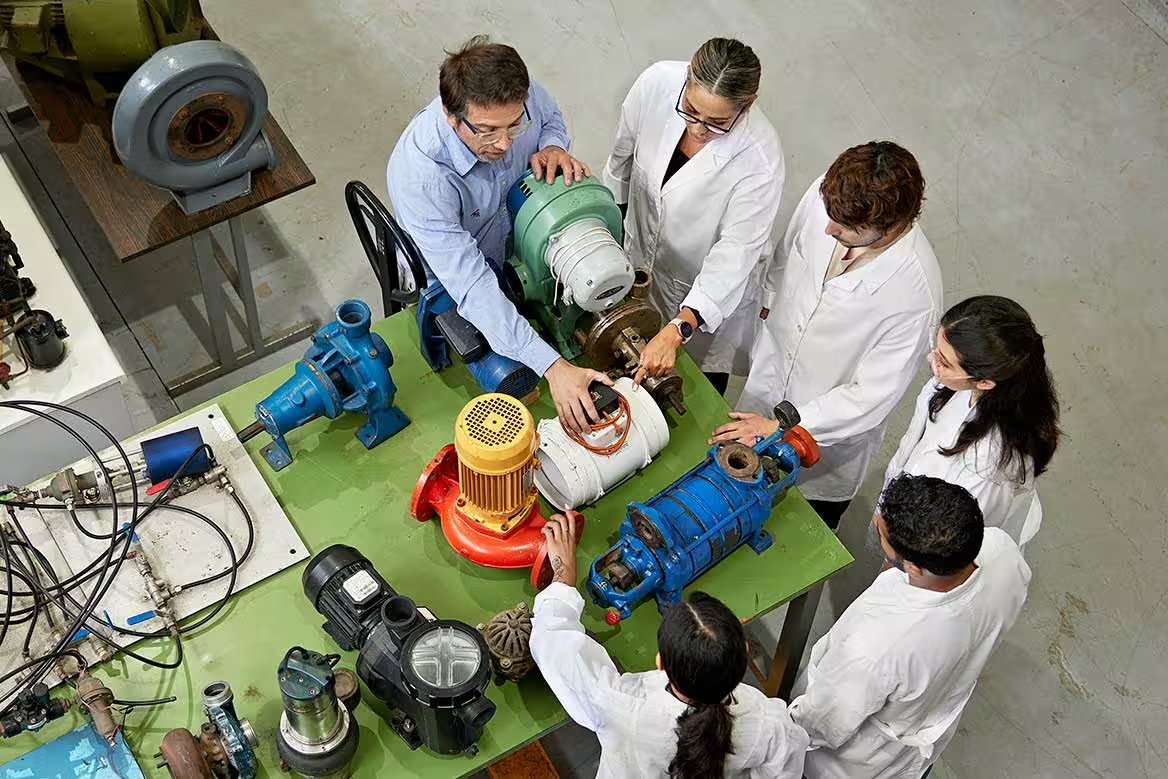
This course provides an overview of the fundamentals of classical physics. Students will concentrate on understanding the physical reality of their everyday experiences of matter and motion and they will learn how to express these concepts through mathematical models and equations. Frequent discussions and lab-based inquiries about the principles of nature and physical phenomena will broaden and deepen students’ realms of experience and knowledge. After completing this course, students will exhibit proficiency in explaining and applying the principles of kinematics, force, work and energy, gravitation and oscillation, light and sound, and electromagnetism. Students will also become more adept at examining evidence, identifying and manipulating variables, and testing their own hypotheses in a laboratory setting.

12th Grade – ASTRONOMY
This course provides an overview of every major topic in modern astronomy. The course progresses from a consideration of the celestial objects that are most easily observable, to those that can be known only through advanced instruments, or by mathematical theory alone. At each stage, students will consider celestial bodies 1) in terms of their relative motions as expressed through mathematical physics; 2) in terms of their observable properties; and 3) in terms of their formation and evolution. Throughout the course, a special emphasis will be placed on understanding physical cosmology as the theoretical basis of the natural sciences.