Summer School Program
Clarity → Excitement → Trust → Action
Build a Summer Experience That Engages, Challenges, and Inspires
For students entering Grades 5–8 — step into a classroom that builds confidence, sharpens thinking, and brings learning to life.
Mix and match classes to create a half-day or ALL-DAY program rooted in creativity, strategy, and confident communication…AND MOST OF ALL – LEARNING THAT’S FUN!
Location: 341 S. Dries St, Saukville, WI
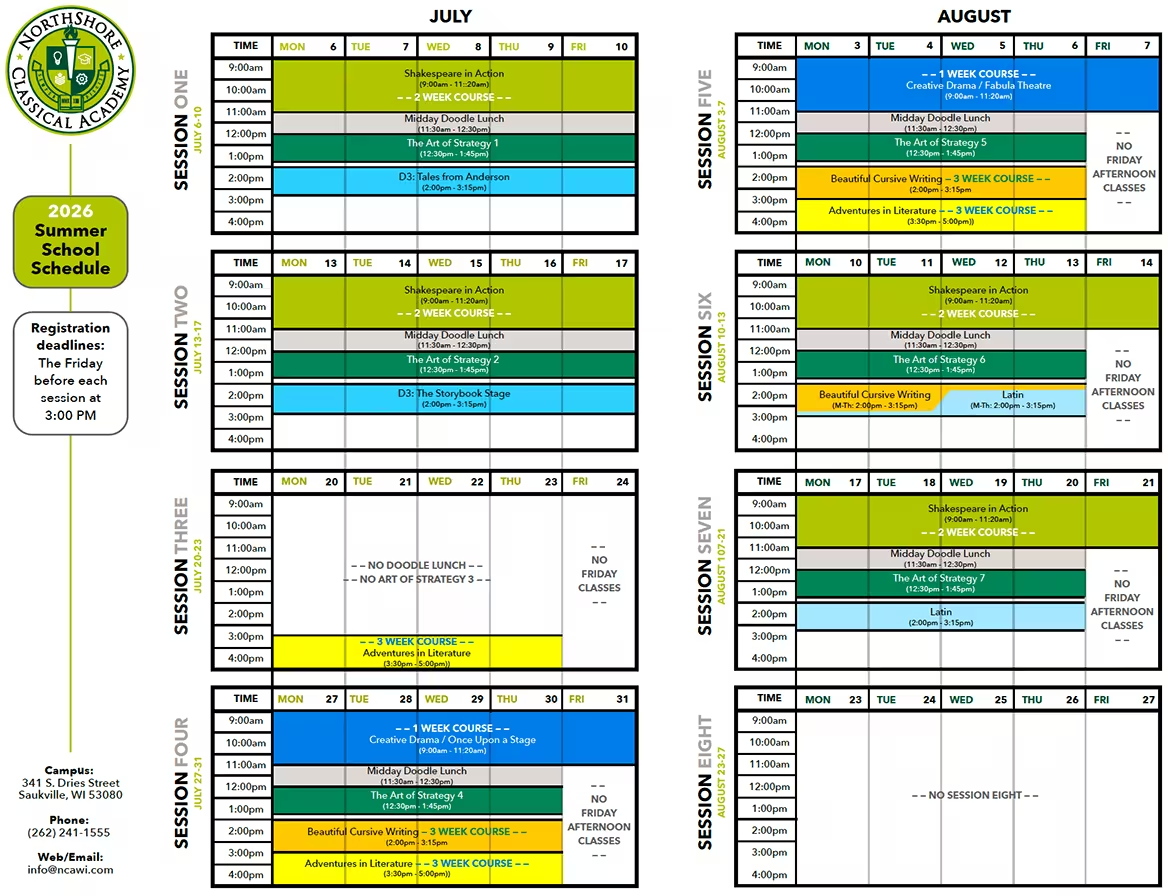
Session TWO: July 13-17
Session THREE: July 20–23
Session FOUR: July 27-31
Session FIVE: August 3–7
Session SIX: August 10-14
Session SEVEN: August 17-21
Grades: 5th – 8th Grade (as of Fall 2026) Small group, discussion-based learning







This Isn’t Just Summer School
Our Summer School Program is designed to give families a firsthand look at a different approach to education—one rooted in discussion, creativity, and the development of confident, capable students.
Build Your Summer Experience
Students can enroll in a single course, a half-day (including lunch) or for the full day! You simply arrange your drop off and pick-up times.
You can even sign up for the entire 7-week Summer schedule!
Shakespeare In Action
(2-Week Course – Session 1 & 2 AND Session 6 & 7)
- Learn More >
Step onto the stage and bring Shakespeare to life! In this engaging middle school course, students explore Julius Caesar through the lens of theatre, learning the fundamentals of acting while uncovering the drama, tension, and excitement of the story. Rather than simply reading the play, students will experience it – using their voices, bodies, and imaginations to make Shakespeare’s words clear, powerful, and alive.
Through interactive rehearsals, theatre games, and scene work, students will build essential acting skills such as projection, articulation, expression, and stage presence. They will learn how to interpret character motivations, work collaboratively with scene partners, and use movement and blocking to tell a compelling story. As they grow more comfortable with Shakespeare’s language, students will gain confidence in speaking it naturally and with purpose.
While the course emphasizes performance, it remains rooted in the classical tradition by engaging students with the play’s themes of ambition, loyalty, and leadership. Students will explore how actors communicate these ideas to an audience, discovering that great theatre is both intellectually rich and emotionally engaging.
Culminating Showcase:
On the final day, students will present Julius Caesar adapted by Kelso. This showcase will highlight their development as performers, featuring memorized lines, thoughtful character choices, and dynamic stage work. Family and friends are invited to attend and celebrate the students’ creativity, collaboration, and growing confidence on stage.
Course Objectives:
- Develop foundational acting skills including voice, movement, and stage presence
- Build confidence in performing Shakespearean language
- Understand character, motivation, and storytelling through performance
- Collaborate effectively in rehearsals and ensemble work
- Prepare and present a theatrical performance for a live audience
Perfect for students ready to move, speak, and shine as they discover Shakespeare from the inside out.
Creative Drama
(1-Week Course – Session 4 & 5)
- Learn More >
Session 4, 5
(4)July 27 – 30, (5)August 3 – 6
TIME: 10:00 – 11:20 AM
Title: Creative Drama
Who: Grades 5 – 8, Fall of 2026
This one-week Creative Drama course for grades 5–8 introduces students to performance, storytelling, and expressive movement within the context of a Classical Education summer program. Meeting daily for almost 90 minutes, students will engage in games, improvisation, and structured scene work designed to build confidence, vocal clarity, and stage presence.
Students will explore and actively engage in creative drama through poetry and children’s stories, bringing language and narrative to life through voice, gesture, and imagination. Emphasis is placed on listening carefully, responding thoughtfully, and collaborating well with others as part of a disciplined ensemble.
Students will also explore character development, simple script interpretation, and the basics of dramatic structure through age-appropriate material. Activities strengthen memory, attention, and expressive communication while encouraging joy in performance. The week culminates in a short informal showcase in the last 30 minutes of class where students present selected scenes, poems, or improvisations where parents and families are invited to attend.
MIDDAY DOODLE LUNCH / 11:30am – 12:30pm
(1-Week Bag Lunch — SESSIONS 1, 2, 4, 5, 6 & 7 – NOTE: Not available Session 3)
- Learn More >
Bring your own lunch — chill & relax (and doodle) together before the Afternoon Courses.
EARLY AFTERNOON / 12:30pm – 1:45pm
The Art of Strategy: Chess & Strategic Games
(1-Week Class — SESSIONS 1, 2, 4, 5, 6 & 7)
- Learn More >
Students enter the world of strategy through the time-honored game of chess alongside other classic games of logic, planning, and skill. Rooted in the principles of Classical Education, this course cultivates disciplined thinking, patience, and the art of wise decision-making.
Students will learn foundational and advanced chess techniques—openings, tactics, and endgames—while also exploring a variety of strategic games that sharpen reasoning and foresight. Through guided instruction, friendly competition, and reflective discussion, campers will develop the ability to anticipate consequences, adapt to changing circumstances, and think several steps ahead.
This course emphasizes the Classical ideals of intellectual virtue and character formation. Students practice perseverance in the face of challenge, humility in both victory and defeat, and respect for worthy opponents. By engaging with games that have endured across centuries, students participate in a rich tradition that values logic, order, and the pursuit of excellence.
Whether a beginner or an experienced player, each student will be challenged to grow in confidence, strategic thinking, and a love for the art of the mind.
AFTERNOON / 2:00pm – 3:15pm
D3: Drama, Dialogue & Discovery
(1-Week Class — SESSIONS 1 & 2)
- Learn More >
NOTE: The content of this course will be different for each week. This means students may take both classes of “Drama, Dialogue, and Discovery” because content will be different, but skills will be the same.
In this engaging middle school theatre course, students will strengthen ensemble work and physical expression while expanding their use of voice, body, and imagination through purposeful theatre games and collaborative scene work. Rooted in the values of a classical education, the course emphasizes not only creativity and performance, but also the formation of clear thinkers, articulate speakers, and confident participants in a shared community.
Each day, students will participate in structured activities that build foundational acting skills—projection, articulation, posture, movement, and stage presence—while also cultivating attentiveness, discipline, and cooperation. Through repetition and playful practice, students develop control of their voices and bodies, learning how to communicate ideas with clarity and intention. Theatre games serve as a dynamic entry point into these skills, reinforcing habits of focus, responsiveness, and joyful learning that are central to the classical tradition.
Special emphasis is placed on ensemble-building, as students learn to listen carefully, respond thoughtfully, and support one another in performance. This collaborative environment reflects the classical goal of preparing students not just as individuals, but as members of a community—capable of working together toward a common purpose with humility and confidence.
As students grow in skill, they will engage their imaginations to create characters, explore movement, and bring stories to life. In doing so, they develop both expressive freedom and disciplined control, forming the habits of mind and body that undergird effective communication and strong character.
Culminating Showcase:
The course will conclude with a Theatre Showcase for parents during the final half hour of the last day. This informal performance will highlight the students’ growth in ensemble work, physical expression, and confident communication, offering a joyful and meaningful presentation of their work.
AFTERNOON / 2:00pm – 3:15pm
Cursive Writing
(3-Week Course — SESSIONS 4, 5 & 6)
- Learn More >
Session 4, 5,6
(4)July 27 – 30, (5)August 3 – 6, (6)August 10 -13
TIME: 2:00 – 3:15 PM
Title: Cursive Writing
Who: Grades 5 – 8, Fall of 2026
Course Description:D’Nealian Cursive Writing works well in a Classical Education high school because it supports both fluent handwriting and the intellectual aims of a classical curriculum.
Its main strength is that it promotes smooth, connected letter formation and transitions naturally from print to cursive. In a classical classroom – where students write frequently for notes, essays, and text analysis – this reduces friction and helps writing feel more automatic, so students can focus more on ideas than letter formation.
That increased fluency also lowers cognitive load. When handwriting becomes automatic, students can devote more attention to argument, comprehension, and synthesis, which are central to classical learning. Faster, more legible cursive makes sustained writing tasks like essay composition and annotation more manageable.
It also fits the classical emphasis on tradition and engagement with historical texts, since cursive resembles the script used in many older manuscripts. This subtly reinforces continuity with the past while students work with classical literature and rhetoric.
Finally, its structured approach to letter formation can help reduce inconsistencies in spacing and legibility, supporting clearer written communication and reinforcing disciplined, careful thinking – key habits in a classical education model.
AFTERNOON / 2:00pm – 3:15pm
Latin
Grades 6 – 8
(SESSIONS 6 & 7: Monday – Thursday, August 10 – 13 and Monday – Thursday, August 17 – 20)
- Learn More >
Welcome to Northshore Classical Academy’s Summer program! Our program exists to educate and prepare students for the next phase of their education with some tailoring for entry into NCA’s traditional yearlong courses. Primary among these is an Introduction to Latin! Students will gain a deeper understanding of the grammar that governs both the English and Latin language and begin to accumulate a Latin vocabulary. Sign your student up to begin their journey through the basics of Latin and provide them a firm foundation for mastering both the English language and Latin.
LATE AFTERNOON / 3:30pm – 5pm
Adventures in Literature
(3-Week Course — SESSIONS 3, 4 & 5)
- Learn More >
Session 3, 4, 5 (July 20 – 23, July 27 – 30, August 3 – 6) (Monday – Thursday each week) 3:30 – 5:00 PM
Title: Adventures in Literature: Little House in the Big Woods
Who: Grades 5 – 8, Fall of 2026
Teaching a novel in this manner is distinctly classical because it treats literature not merely as content to be covered, but as a means of forming the whole student—mind, character, and imagination. Classical education is rooted in the pursuit of truth, goodness, and beauty, and great works of literature invite students into that pursuit by presenting enduring questions about human nature, virtue, and moral choice.
By engaging the text through the structure of the Trivium, students first learn to attend carefully to language and meaning, developing habits of focus and accuracy. They then practice reasoning well, analyzing characters and events with an eye toward cause, consequence, and ethical judgment. Finally, they are called to articulate their understanding clearly and persuasively, cultivating the ability to speak and write with clarity and conviction. This progression reflects the natural development of the student and trains them not only in knowledge, but in wisdom.
Such study is important because it forms students who can think deeply rather than react superficially. In an age of speed and distraction, reading a novel slowly and thoughtfully teaches patience, attention, and intellectual discipline. More significantly, it shapes the moral imagination: students learn to recognize virtue and vice, to consider the weight of human decisions, and to discern what is worthy of admiration or critique.
Literature, when taught classically, becomes a conversation across time. Students encounter ideas that have endured for generations and learn that their own lives participate in a larger human story. This fosters humility, perspective, and a sense of responsibility.
Ultimately, this approach matters because it aims beyond academic success. It seeks to cultivate students of sound judgment and strong character – young people who can think clearly, speak well, and engage the world with wisdom.
———————
A classical approach doesn’t treat Little House in the Big Woods as just a children’s story—it treats it as a way to form character, attention, moral judgement, and a love of the simple, good things in life.
This course will delve further into the classical lessons Ingall’s teaches in this novel beginning with Virtue and Character Formation by examining industry (work ethic), self-discipline, and gratitude. Living in Harmony with Nature is another theme students will explore by observing real life and how seasons guide our lives, how nature is ordered and meaningful, and how people depend on creation. Students will also study Family and Social Order within the context of the novel. A focus on Narration and Memory will also be exercised by retelling scenes and acting them out. Though Little House in the Big Woods feels like a story, it is also a window into the 19th century pioneer life. Continuing our Classical Education viewpoint, students will also cultivate an appreciation for beauty, music, storytelling, and handmade goods within this story’s context.

Instructor Sarah Foster brings over 30 years of teaching experience at the middle school and high school level to our Summer Program. She has taught drama, reading, communication and civics classes that truly engage young minds.

FREE OFFER
for Book lovers
We’ll send you four beautiful Classic bookmarks and ask that you simply share extras with young readers.
(Wisconsin residents only)

"*" indicates required fields